Product / Material system
The cooling event happens in the material.
Three components, one passive sequence, no refrigerant anywhere on the facade.
- Components
- 3
- Peak surface
- −12°C
- Latent potential
- ≈0.63 kWh/L
Product architecture
A ceramic skin that cools before heat gets in.
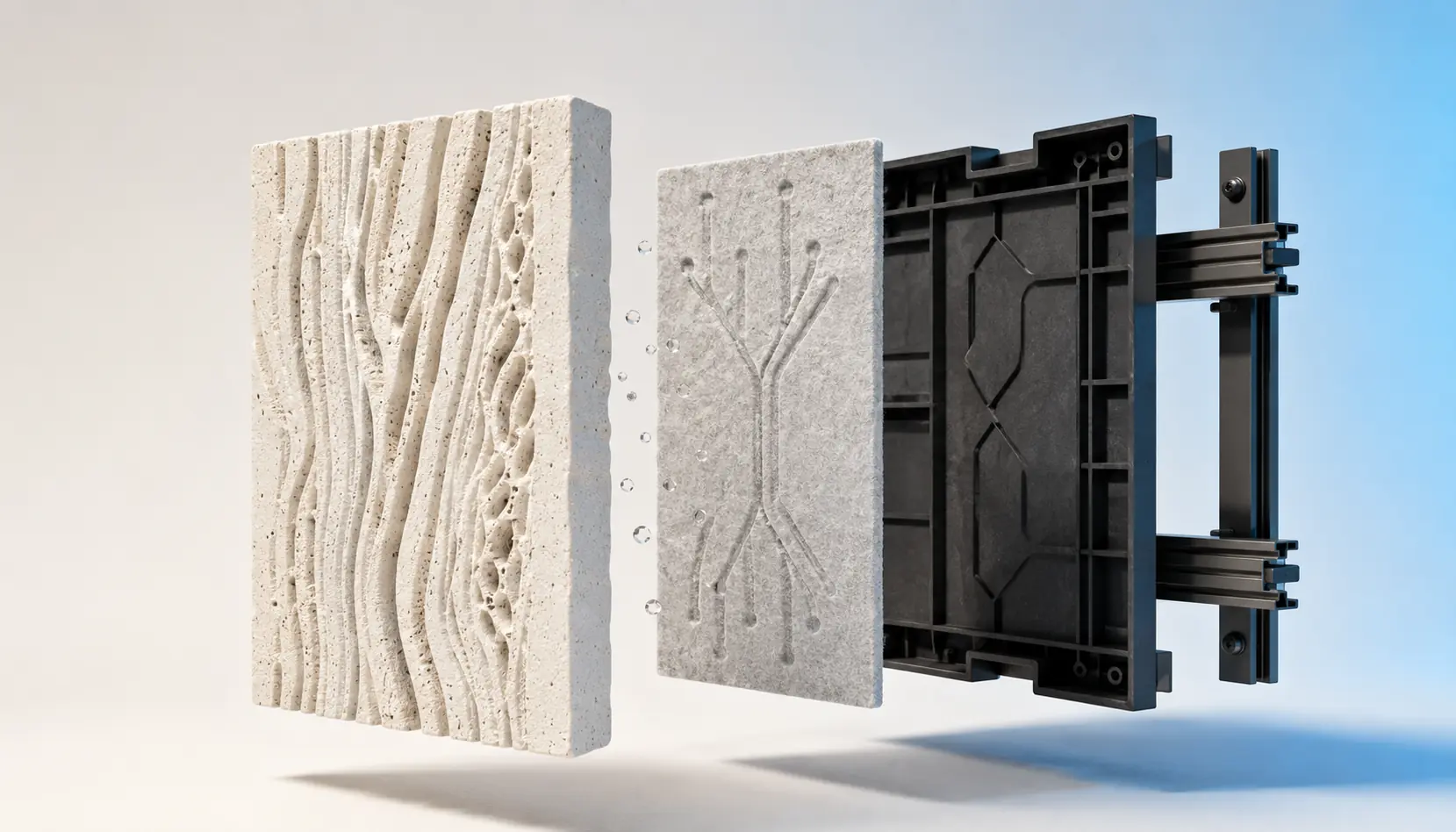
A modular rainscreen tile combines porous ceramic, a capillary wick and a standard rail cassette.
- 01
POROUS FACE
Micro-grooves spread water across the sun-facing surface, holding an even film where the solar load lands.
- 02
MINERAL WICK
Capillary channels distribute water without high pressure, so the system runs on gravity and material, not pumps.
- 03
RAIL CASSETTE
A dry-mounted rear module fits familiar facade practice and stays reversible for maintenance or retrofit.
- No refrigerant
- No facade compressor
- Dry-mounted module
How it works
Water travels. Heat leaves.
A passive thermodynamic sequence in three material actions.
CAPTURE
A low-flow feed wets the mineral wick along the top of each cassette.
SPREAD
Capillary grooves create an even film across the whole ceramic face.
RELEASE
Evaporation removes heat at the surface, before it reaches the envelope.
Thermodynamic potential; actual performance varies with climate, water quality and system design.
The proof case
The facade stays cooler when demand peaks.
Simulated hot-day surface temperature / °C
- Conventional facade
- NIVAL facade
Illustrative simulation for a speculative portfolio concept; not a certified test result.
Where it goes
One system. Three facade conditions.
New build, retrofit and solar control share the same panel, wick and rail logic.